
The CBSE is getting ready to make big changes to the CBSE curriculum. The newest curriculum for 2026-27 says that students will start learning about artificial intelligence (AI) in Class 9 and that they will have to learn three languages starting in Class 6.
CBSE is also going to make the academic framework stronger so that kids can be ready for competitive exams. Including JEE and NEET starting in ninth grade.
The New Education Policy (NEP 2020) brought about these changes. They want to make education more about ideas, technology, and preparing students for jobs in the future, rather than just reading books. If these reforms are implemented, the way students pursue their education could be very different.
JEE and NEET Preparation to Begin in Schools from Class 9 Onwards—CBSE Curriculum Update 2026 No. 1
The major update to the CBSE curriculum will be the embedding of the JEE-NEET framework in the class 9 syllabus.
Yes, you read it right: CBSE will now mold the syllabus and paper pattern according to the formats of competitive exams like JEE, NEET, CUET, etc.
CBSE is bringing this update to reduce students’ dependence on coaching. Until now, students who wanted to appear in exams like JEE and NEET had to join coaching for preparation, as the exam paper levels are higher than those in the board curriculum. As a result, over the past few years, students have shifted their focus from schools to coaching.
Hence, CBSE proposed a solution to level the curriculum and provide the JEE/NEET-level syllabus in schools.
This change will strengthen the school syllabus and prepare students for competitive exams without the need for extra coaching, simply by doing their board studies.
CBSE to Increase Competency Based Questions in CBSE 2026
Rolling out Time
From the 2026-27 session, CBSE will add the JEE-NEET-level frameworks to the exams.
AI in CBSE Curriculum From 9th Class: CBSE Curriculum Update 2026 No. 2
The second major update to the CBSE curriculum focuses on AI and computational thinking. The board is all set to integrate these two aspects into the CBSE curriculum from class 9th.
The objective of the CBSE is to enable students to acquire a foundational understanding of technology and the digital world from a young age.
In subjects related to AI, students will be taught the following:
- How data works
- How computers solve problems
- The various fields in which Artificial Intelligence is being utilised
- The role of AI in everyday life
Through this change in the CBSE curriculum, the board is trying to foster the development of both logical thinking and technical understanding among students.
Rolling Out Time
As of now, the curriculum will be added from the next session. Moreover, AI subject exam will be mandatory from 2029.
Three languages Will Be Compulsory from Class 6: CBSE Curriculum Update 202 No. 3
The three-language formula will also be implemented in the new CBSE curriculum. According to this, students will be required to study three languages starting from Class 6.
Additionally, there is one vertical in this update; two of these three compulsory languages must be Indian languages.
For example, if a student chooses to study English, the remaining two languages could be Hindi, Sanskrit, or any other Indian language.
The objective of this change is to keep students connected with Indian languages and culture.
Rolling Out Time
From the next session, 2026-27, three languages will be mandatory from class 6th.
Two Levels in Maths & Science From Class 9th: CBSE Curriculum Update 2026 No. 4
Another major change for CBSE classes 9 and above will be dual-level instruction in Maths and Science. In the new CBSE curriculum, the board plans to introduce two levels in two subjects: maths and science.
Basic and Advanced levels in Maths and Science in CBSE
As per the new curriculum, students will have the option to take these two-level papers in math and science.
The basic one will be mandatory for everyone, and it is the same as in previous years. It will be an 80-mark section that will be the primary one, and everyone has to take it.
But, a new level, the advanced level, will be there, worth 25 marks. This will be an optional section; students can choose it.
But, there is a catch: marks of the advanced section will not be included in the final score; only the basic section score will be calculated. However, if any student scores above 50% in the advanced section, the score will be listed separately on the marksheet.
Rolling Out Time
This will be implemented from the next session, 2026-27.
CBSE’ New Assessment Pattern: CBSE Curriculum Update 2026 No. 5
The last chance in the new CBSE curriculum is the new assessment pattern. The motto behind this change is to ensure that students focus equally on memorisation and practical learning. Consequently, the examination pattern will be made more competency-based in the near future.
Under the new framework, internal assessment may be broadly categorized into four components:
- Periodic Tests
- Multiple Assessments
- Portfolio Work
- Subject Enrichment Activities
Moreover, in the board exams, approximately 50% of the questions may be based on case studies, data analysis, and application-oriented scenarios.
Rolling Out Time
The assessment will be rolled out in the upcoming section in full. However, the board will start holding a separate exam of the business subject in the 2027-28 session.


A Last Few Words
By the end of the article, you must have realised that the CBSEis not the same anymore. You will have to change the approach you have been using so far. And not only will your teachers and school have to mould themselves according to the CBSE updated curriculum 2026-27.
As for its impact on you, it is certain to affect students in both negative and positive ways. If you embrace these changes, they will prove beneficial to you; conversely, if you continue to study using the same old methods, you will witness the detrimental consequences in your marks during the next academic session.
Your School’s Role in This is significant.
Your school will be the most important part of the process of getting used to these changes. The new CBSE curriculum will only work if schools give children a place to learn that encourages concept-based learning, technology literacy, and meeting the requirements of competitive exams.
A “Best CBSE School” is one that does more than just teach the syllabus. It also gets pupils ready for future competitive exams and their future jobs.
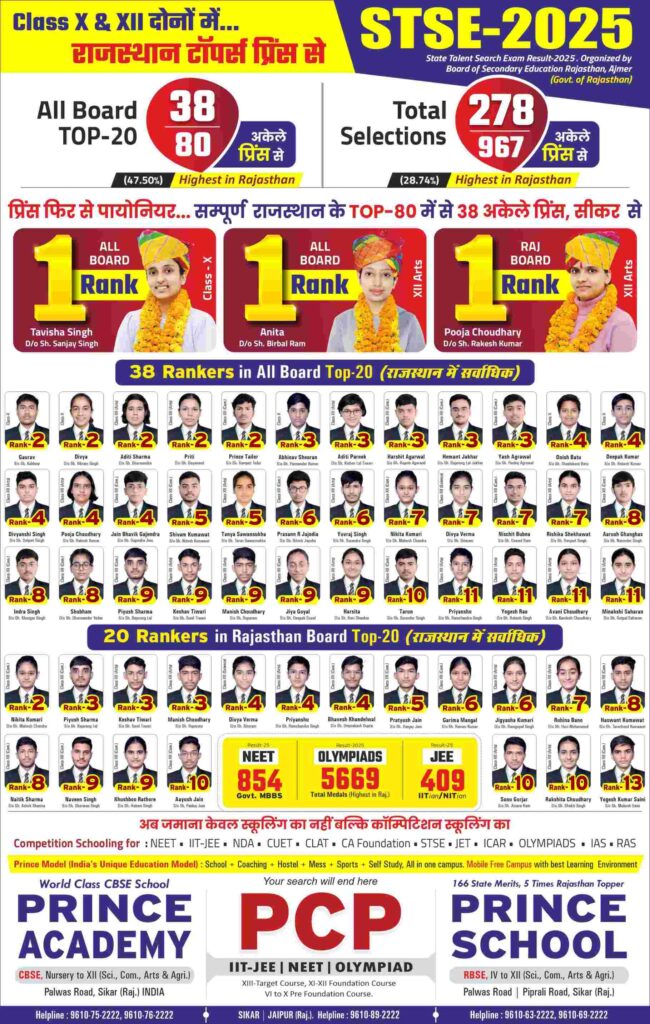
In this situation, several schools have already moved away from the traditional style of schooling and adopted a “competition schooling model.” For example, Prince Academy has long used a methodology in which students learn at a level of competitive exams in addition to the regular CBSE curriculum. This helps them create a strong base for