
The day for the NEET UG 2026 aspirants has arrived, when the new syllabus gets released for the upcoming exam. Yes, you heard it right: the NMC (National Medical Council) has released the updated NEET syllabus 2026.
On 22nd December 2025, the NMC website featured this update from the Director of UGMEB (Undergraduate Medical Exam Body). This notice was to inform all the applicants and medical colleges under the NMC that the updated NEET syllabus 2026 has been released. And all NEET 2026 aspirants must prepare according to the new NEET 2026 syllabus.
Has the NEET 2026 Syllabus Changed?
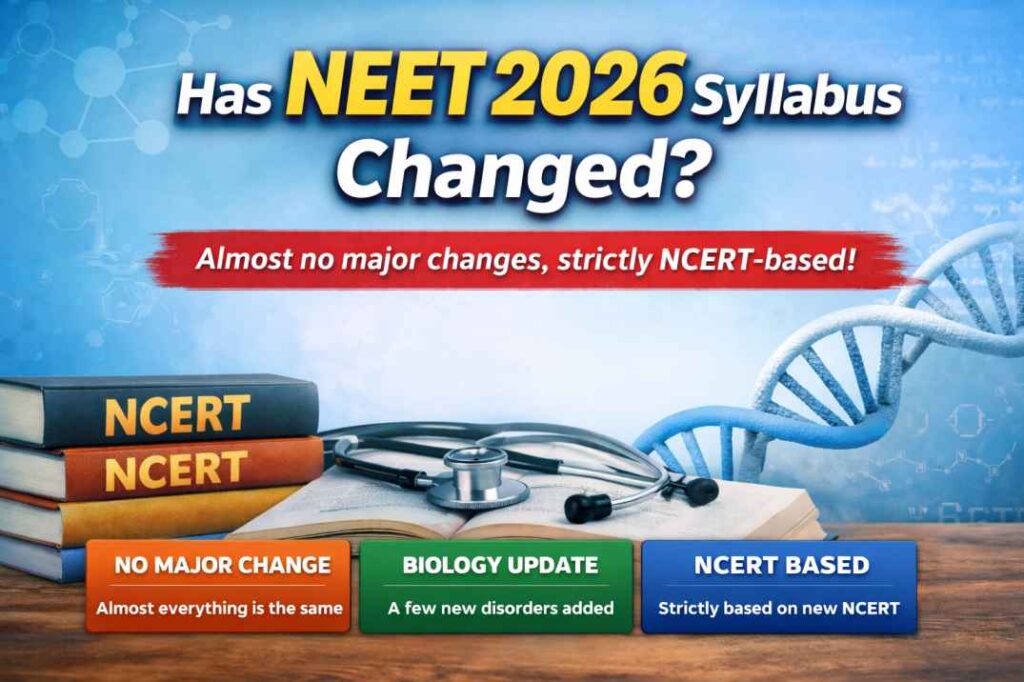
For quite some time, students have been wondering whether any major changes have been made to the NEET UG 2026 syllabus. When the officially released NEET UG 2026 syllabus is compared to last year’s syllabus (NEET UG 2025), it becomes clear that no major or fundamental changes have been made. The Physics and Chemistry syllabi remain exactly the same, while the structure and chapters in Biology are also unchanged. Only a few disorders have been added to the Human Physiology section, which students are already familiar with from their NCERT textbooks.
Another important point is that the entire NEET UG 2026 syllabus is completely based on the new NCERT textbooks. It would not be wrong to say that the syllabus has been adopted almost verbatim from the new NCERT. Therefore, students whose preparation is strong based on the NCERT books do not need to worry about any new patterns or additional topics. The correct strategy is to continue preparing by studying the NCERT textbooks line by line.
Updated NEET Syllabus 2026: Physics, Chemistry, Biology
Here, we have listed all three syllabi of NEET UG 2026. You can check it subject-wise or download the PDF from below the article.
NEET 2026 Physics Syllabus
| Unit No. | Unit Name | Topics Covered |
| Unit 1 | Physics and Measurement | Units of measurement, System of Units, SI units, fundamental and derived units, least count, significant figures, errors in measurement, dimensions of physical quantities, dimensional analysis and its applications |
| Unit 2 | Kinematics | Frame of reference, motion in a straight line, position–time graph, speed and velocity, uniform and non-uniform motion, average and instantaneous velocity, uniformly accelerated motion, equations of motion, scalars and vectors, vector addition and subtraction, unit vectors, relative velocity, motion in a plane, projectile motion, uniform circular motion |
| Unit 3 | Laws of Motion | Force and inertia, Newton’s laws of motion, momentum, impulse, conservation of linear momentum, equilibrium of concurrent forces, static and kinetic friction, laws of friction, rolling friction, centripetal force and applications (vehicle on level and banked roads) |
| Unit 4 | Work, Energy and Power | Work done by constant and variable force, kinetic and potential energy, work–energy theorem, power, potential energy of spring, conservation of mechanical energy, conservative and non-conservative forces, motion in a vertical circle, elastic and inelastic collisions (one and two dimensions) |
| Unit 5 | Rotational Motion | Centre of mass (two-particle system and rigid body), torque, angular momentum, conservation of angular momentum, moment of inertia, radius of gyration, moments of inertia of simple geometrical bodies, parallel and perpendicular axis theorems, equilibrium of rigid bodies, equations of rotational motion |
| Unit 6 | Gravitation | Universal law of gravitation, acceleration due to gravity and its variation, Kepler’s laws, gravitational potential energy and potential, escape velocity, motion of satellites, orbital velocity, time period and energy of satellite |
| Unit 7 | Properties of Solids and Liquids | Elastic behaviour, stress–strain, Hooke’s law, Young’s modulus, bulk modulus, modulus of rigidity, pressure in fluids, Pascal’s law, viscosity, Stokes’ law, terminal velocity, streamline and turbulent flow, Bernoulli’s principle, surface tension, capillarity, thermal expansion, calorimetry, change of state, heat transfer |
| Unit 8 | Thermodynamics | Thermal equilibrium, zeroth law of thermodynamics, heat, work and internal energy, first law of thermodynamics, isothermal and adiabatic processes, second law of thermodynamics, reversible and irreversible processes |
| Unit 9 | Kinetic Theory of Gases | Equation of state of a perfect gas, kinetic theory assumptions, pressure of a gas, RMS speed, degrees of freedom, law of equipartition of energy, specific heat capacities, mean free path, Avogadro’s number |
| Unit 10 | Oscillations and Waves | Periodic motion, simple harmonic motion, time period, frequency, energy in SHM, simple pendulum, wave motion, longitudinal and transverse waves, speed of wave, superposition principle, standing waves, harmonics, beats |
| Unit 11 | Electrostatics | Electric charge and conservation, Coulomb’s law, electric field and field lines, electric dipole, torque on dipole, electric flux, Gauss’s law and applications, electric potential, equipotential surfaces, capacitors, combination of capacitors, energy stored in a capacitor |
| Unit 12 | Current Electricity | Electric current, drift velocity, Ohm’s law, resistance, resistivity, V–I characteristics, electrical energy and power, series and parallel combination of resistors, temperature dependence of resistance, EMF, internal resistance, Kirchhoff’s laws, Wheatstone bridge, metre bridge |
| Unit 13 | Magnetic Effects of Current and Magnetism | Biot–Savart law, Ampere’s law, force on moving charge and current-carrying conductor, torque on current loop, moving coil galvanometer, magnetic dipole, bar magnet, Earth’s magnetism, para-, dia- and ferromagnetic substances |
| Unit 14 | Electromagnetic Induction and Alternating Currents | Faraday’s laws, induced EMF and current, Lenz’s law, eddy currents, self and mutual inductance, AC circuits, RMS values, reactance, impedance, resonance, AC generator, transformer |
| Unit 15 | Electromagnetic Waves | Displacement current, electromagnetic waves, characteristics, electromagnetic spectrum (radio waves to gamma rays) and applications |
| Unit 16 | Optics | Reflection and refraction, spherical mirrors, mirror formula, refraction at plane and spherical surfaces, lenses, lens maker’s formula, total internal reflection, optical instruments, wave optics, interference, diffraction, polarization |
| Unit 17 | Dual Nature of Matter and Radiation | Photoelectric effect, Einstein’s photoelectric equation, wave–particle duality, de Broglie wavelength |
| Unit 18 | Atoms and Nuclei | Alpha particle scattering, Rutherford and Bohr models, energy levels, hydrogen spectrum, nuclear composition, mass defect, binding energy, nuclear fission and fusion |
| Unit 19 | Electronic Devices | Semiconductors, p–n junction diode, I–V characteristics, rectifier, LED, photodiode, solar cell, Zener diode, logic gates (AND, OR, NOT, NAND, NOR) |
| Unit 20 | Experimental Skills | Vernier callipers, screw gauge, simple pendulum, metre scale, Young’s modulus, surface tension, viscosity, speed of sound, specific heat, resistivity, Ohm’s law, galvanometer, focal length of mirrors and lenses, prism, diode characteristics. |
NEET 2026 Chemistry Syllabus
Physical Chemistry
| Unit No. | Unit Name | Topics Covered |
| Unit 1 | Some Basic Concepts in Chemistry | Matter and its nature, Dalton’s atomic theory, atom, molecule, element and compound, laws of chemical combination, atomic and molecular masses, mole concept, molar mass, percentage composition, empirical and molecular formulae, chemical equations and stoichiometry |
| Unit 2 | Atomic Structure | Nature of electromagnetic radiation, photoelectric effect, hydrogen spectrum, Bohr model and limitations, dual nature of matter, de Broglie relation, Heisenberg uncertainty principle, quantum mechanical model of atom, atomic orbitals, quantum numbers, shapes of orbitals, electronic configuration, Aufbau principle, Pauli’s exclusion principle, Hund’s rule |
| Unit 3 | Chemical Bonding and Molecular Structure | Ionic and covalent bonding, lattice enthalpy, electronegativity, Fajan’s rule, dipole moment, VSEPR theory, valence bond theory, hybridization, resonance, molecular orbital theory, bond order, bond length, bond energy, metallic bonding, hydrogen bonding |
| Unit 4 | Chemical Thermodynamics | System and surroundings, state functions, types of processes, first law of thermodynamics, work, heat, internal energy, enthalpy, Hess’s law, enthalpies of bond dissociation, formation, combustion, atomization, hydration, solution, second law of thermodynamics, entropy, Gibbs free energy and equilibrium |
| Unit 5 | Solutions | Concentration terms, Raoult’s law, ideal and non-ideal solutions, vapour pressure, colligative properties, determination of molar mass, abnormal molar mass, van’t Hoff factor |
| Unit 6 | Equilibrium | Physical equilibrium, chemical equilibrium, equilibrium constants (Kp, Kc), factors affecting equilibrium, Le Chatelier’s principle, ionic equilibrium, acids and bases, pH scale, hydrolysis of salts, buffer solutions, solubility product |
| Unit 7 | Redox Reactions and Electrochemistry | Oxidation and reduction, redox reactions, oxidation number, balancing redox equations, electrochemical cells, electrolytic and galvanic cells, electrode potential, Nernst equation, EMF, relation between Gibbs energy and cell potential, batteries and fuel cells |
| Unit 8 | Chemical Kinetics | Rate of reaction, factors affecting rate, order and molecularity, rate law, rate constant, integrated rate equations, half-life, Arrhenius equation, activation energy, collision theory |
Inorganic Chemistry Chapters and Topics
| Unit No. | Unit Name | Topics Covered |
| Unit 9 | Classification of Elements and Periodicity in Properties | Modern periodic law, periodic table, periodic trends in atomic and ionic radii, ionisation enthalpy, electron gain enthalpy, valency, oxidation states, chemical reactivity |
| Unit 10 | p-Block Elements | Group 13 to Group 18 elements, electronic configuration, physical and chemical properties, trends in groups and periods, unique behaviour of the first element of each group |
| Unit 11 | d- and f-Block Elements | Transition elements, electronic configuration, properties, oxidation states, colour, catalytic behaviour, magnetic properties, preparation and properties of K₂Cr₂O₇ and KMnO₄, lanthanoids and actinoids |
| Unit 12 | Coordination Compounds | Werner’s theory, ligands, coordination number, denticity, chelation, IUPAC nomenclature, isomerism, valence bond theory, crystal field theory, colour and magnetic properties, importance of coordination compounds |
Organic Chemistry Chapters
| Unit No. | Unit Name | Topics Covered |
| Unit 13 | Purification and Characterisation of Organic Compounds | Purification methods, qualitative analysis of elements, quantitative analysis, empirical and molecular formulae |
| Unit 14 | Some Basic Principles of Organic Chemistry | Tetravalency of carbon, hybridisation, classification of organic compounds, homologous series, isomerism, IUPAC nomenclature, electronic effects, reaction mechanisms, types of organic reactions |
| Unit 15 | Hydrocarbons | Alkanes, alkenes, alkynes, aromatic hydrocarbons, preparation, properties, reactions, electrophilic substitution, ozonolysis, polymerisation |
| Unit 16 | Organic Compounds Containing Halogens | Preparation, properties, reactions, nature of C–X bond, substitution reactions, environmental effects |
| Unit 17 | Organic Compounds Containing Oxygen | Alcohols, phenols, ethers, aldehydes, ketones, carboxylic acids – preparation, properties, reactions, uses |
| Unit 18 | Organic Compounds Containing Nitrogen | Amines and diazonium salts – preparation, properties, reactions and uses |
| Unit 19 | Biomolecules | Carbohydrates, proteins, enzymes, vitamins, nucleic acids, hormones |
| Unit 20 | Principles Related to Practical Chemistry | Detection of functional groups, preparation of inorganic and organic compounds, titrimetric exercises, qualitative salt analysis, and basic chemical experiments |
NEET 2026 Biology + Botany Syllabus
| Unit No. | Unit Name | Topics Covered |
| Unit 1 | Diversity in Living World | What is living, biodiversity, need for classification, taxonomy and systematics, concept of species and taxonomical hierarchy, binomial nomenclature, five kingdom classification, Monera, Protista, Fungi, Lichens, Viruses and Viroids, plant kingdom (Algae, Bryophytes, Pteridophytes, Gymnosperms), animal kingdom (non-chordates and chordates) |
| Unit 2 | Structural Organisation in Animals and Plants | Morphology of flowering plants, plant tissues, anatomy of flowering plants (root, stem, leaf), inflorescence, flower, fruit and seed, families (Malvaceae, Cruciferae, Leguminosae, Compositae, Gramineae), animal tissues, anatomy and physiology of frog (brief) |
| Unit 3 | Cell Structure and Function | Cell theory, prokaryotic and eukaryotic cells, plant and animal cells, cell membrane and cell wall, cell organelles, endomembrane system, mitochondria, ribosomes, plastids, cytoskeleton, nucleus, biomolecules, enzymes, cell cycle, mitosis and meiosis |
| Unit 4 | Plant Physiology | Photosynthesis, pigments, light and dark reactions, cyclic and non-cyclic photophosphorylation, chemiosmotic hypothesis, photorespiration, C3 and C4 pathways, respiration in plants, glycolysis, TCA cycle, ETS, plant growth and development, plant hormones |
| Unit 5 | Human Physiology | Breathing and respiration, body fluids and circulation, blood and heart, excretory products and their elimination, osmoregulation, locomotion and movement, neural control and coordination, endocrine system, hormonal regulation, human disorders and diseases |
| Unit 6 | Reproduction | Sexual reproduction in flowering plants, pollination and fertilization, seed and fruit development, apomixis and polyembryony, human reproductive system, gametogenesis, menstrual cycle, fertilisation, pregnancy, parturition, lactation, reproductive health, contraception, infertility and assisted reproductive technologies |
| Unit 7 | Genetics and Evolution | Mendelian inheritance, deviations from Mendelism, chromosomal theory of inheritance, linkage and crossing over, sex determination, sex-linked inheritance, Mendelian and chromosomal disorders, molecular basis of inheritance, DNA and RNA, replication, transcription, translation, gene regulation, evolution and theories of evolution |
| Unit 8 | Biology and Human Welfare | Health and disease, pathogens and parasites, human diseases, immunity and vaccines, cancer, HIV/AIDS, adolescence, drug and alcohol abuse, microbes in human welfare, industrial applications, sewage treatment, biofertilizers |
| Unit 9 | Biotechnology and Its Applications | Principles and processes of biotechnology, genetic engineering, recombinant DNA technology, applications in health and agriculture, GM crops, transgenic animals, biosafety issues, biopiracy and patents |
| Unit 10 | Ecology and Environment | Organisms and environment, population interactions, population attributes, ecosystem structure and function, energy flow, ecological pyramids, biodiversity and conservation, environmental issues, national parks, sanctuaries, biosphere reserves |
Download Updated NEET Syllabus 2026 PDF – Download Here
Takeaways for Students From the Updated NEET Syllabus 2026
- No significant changes: The NEET 2026 syllabus is almost identical to the NEET 2025 syllabus.
- Minor additions in Biology: A few disorders have been added to Human Physiology, which were already present in the NCERT textbooks.
- Completely NCERT-based: The syllabus is derived entirely from the new NCERT textbooks—NCERT remains the most critical resource.
- Focus on Concepts + Experiments: Experimental skills are still crucial in Physics and Chemistry.
- Effective preparation strategy: Read the NCERT textbooks line by line, and focus on previous year questions (PYQs) and mock tests so that you can fight the competition in NEET 2026.
- Less confusion, more focus: The lack of changes allows for complete concentration on preparation.